Miyazaki
is well known for his female protagonists’ strength. In my blossay I will be
exploring three of these protagonists. The films I will be looking at consist
of Spirited Away, Princess Mononoke, and Nausicaa. These films are all
extremely powerful and their protagonists face great difficulties in their
stories. Miyazaki's female characters make themselves remembered through their
strengths. They are representations of who many of us aspire to be. "Many
of Miyazaki's female characters are remarkable for taking charge of their
lives" (1).

To begin
with, Spirited Away focuses on a ten year old girl named Chihiro. Chihiro and
her parents enter into a strange place that seems like an abandoned carnival
and her parents end up finding a food station with a ton of food. Chihiro who
has been freaked out since they left their car, refuses to join her parents who
are eating at the abandoned buffet. Chihiro
is actually the most unique protagonist of the three I am going to focus on.
This is due to the fact that where almost all of Miyazaki's protagonists come
across great problems, they tend to only be triggered by anger to act out.
Chihiro is afraid of everything when she arrives in the spirit world. She is
constantly panicking at each new aspect of the world that she is exposed to.
She is not brave or powerful or even competent. She actually matches, in many
ways, her antagonist's description of her: that she is pathetic and stupid.
Chihiro gains strength throughout the film, learning to stand on her own two
feet rather than rely on her new friend Haku who saved her life. Still, she is
seen as a crybaby who has never worked in her life. What she does have from the
beginning is the stubbornness that goes along with Miyazaki heroines. She
demonstrates this when she first comes into contact with Yubaba, our main
antagonist in the film. When Chihiro comes to seek a job with her in order to
be able to remain in the spirit world unharmed, Yubaba tries to talk the girl
out of it and deny her the position. Chihiro, despite her fear of Yubaba, holds
her ground and continues asking for work. She does this in spite of having her
mouth zipped shut, something that must have been shocking, and Yubaba's
threats. When Yubaba finally allows Chihiro to sign a work contract, Yubaba
takes away Chihiro's name, making her Sen.
Chihiro does not panic about her loss of name. She seems to take this
one fact in stride. Her character is highly loyal to those she considers her
friends or family. This is perhaps most evident in the way she deals with Haku,
although it first becomes known when she goes to talk to her parents and yells
that she won't let them be eaten and that she would save them. Chihiro is the
character that grows the most in her story. She works hard, if cluelessly at
the bathhouse. Her transformation from a crybaby to a brave child is a slow and
steady process where as my other protagonists are really much more
straightforward. Susan Napier says that
"the whiny and sullen Chihiro also stands in strong contrast to virtually
every other Miyazaki child protagonist" (3), but I strongly disagree with
this overly simplistic view of Chihiro. It only focuses on one aspect of
Chihiro and ignores others that show her to be as brave and committed as any of
Miyazaki's character. The quote is a bit of a dig at Chihiro's character,
saying that she is only a "whiny and sullen child" but I think it is
the transformation and perseverance through her fears and doubts that make
Chihiro worthy of being a Miyazaki character. She faces two major challenges:
dealing with Noh Face and saving Haku. In working to save Haku after she sees
that he is being attacked by thousands of small paper cutouts, she is
determined to save Haku no matter what adversaries she must face. Her first act
is to save him from being pushed to his death by the three heads. She stands
against the three heads and the tyrannical baby of Yubaba's who wants to be
played with. She wrestles with Haku in his dragon form to get him to eat the
medicine that she got from the river god that she helped by noticing that there
was a "thorn" stuck in his side that turns out to be a bicycle.
 What
I find most interesting about her bravery is that she is not fearless in her
bravery, merely determined to do what she needs to. She feeds the rest of the
medicine to Noh Face to get him to be healthy again and lets him accompany her.
Her version of bravery is so much stronger than it would be in an inherently
brave character because she overcomes her fear and conquers it. She learns how
to deal with everything.
but I strongly disagree with
this overly simplistic view of Chihiro. It only focuses on one aspect of
Chihiro and ignores others that show her to be as brave and committed as any of
Miyazaki's character. The quote is a bit of a dig at Chihiro's character,
saying that she is only a "whiny and sullen child" but I think it is
the transformation and perseverance through her fears and doubts that make
Chihiro worthy of being a Miyazaki character. She faces two major challenges:
dealing with Noh Face and saving Haku. In working to save Haku after she sees
that he is being attacked by thousands of small paper cutouts, she is
determined to save Haku no matter what adversaries she must face. Her first act
is to save him from being pushed to his death by the three heads. She stands
against the three heads and the tyrannical baby of Yubaba's who wants to be
played with. She wrestles with Haku in his dragon form to get him to eat the
medicine that she got from the river god that she helped by noticing that there
was a "thorn" stuck in his side that turns out to be a bicycle. What
I find most interesting about her bravery is that she is not fearless in her
bravery, merely determined to do what she needs to. She feeds the rest of the
medicine to Noh Face to get him to be healthy again and lets him accompany her.
Her version of bravery is so much stronger than it would be in an inherently
brave character because she overcomes her fear and conquers it. She learns how
to deal with everything.
Princess
Mononoke on the other hand is brave and fearless throughout the film. She is
powerful and harnesses her instincts gained from living with the wolves to be a
fearsome warrior. Princess Mononoke is a teenager or very young adult and the
challenges she faces are harder and in a wider context than her life and a few
others. She is embroiled in a war between man and nature, both internally and
externally. She lacks the diplomacy and understanding of Nausicaa and Chihiro
respectively. She is dedicated to the protection of the forest and the deer god
and is not afraid of death for herself. She is impulsive and aggressive as seen
by her battle with Lady Eboshi. When the two fight at the iron works, the two
seem evenly matched although Princess Mononoke has already fought several
guards and been shot off the roof. Ashitaka, the main male character that
connects Princess Mononoke's and Lady Eboshi's world, steps between the two
women to stop the fight causing rage from the Lady Eboshi's people as he knocks
both women unconscious. Despite Princess Mononoke's hatred of human beings
because of what they did to the forest, when Ashitaka is shot, she takes him to
be healed by the deer god. Mononoke's hatred of human beings is one of her
driving forces, along with her family, the wolves. She is okay with killing if
she needs to, although she did not try to kill anyone besides Lady Eboshi who
is the main source of danger. She is willing to fight to save her home and even
follow the boars to their deaths in order to help her friend, the leader of the
boars. One thing that really strikes me about Mononoke is that she does not
really change in any discernible way in the film. She remains strong and loyal
to the forest and continues to hate humans. She would have let her rage lead
her to murder the injured Lady Eboshi. Her personality is unaltering. She does not learn to compromise with anyone
or communicate. The closest she comes is with Ashitaka, who she has fallen in
love with, when she wants to kill Lady Eboshi, and that is less of a discussion
than Ahitaka's unfaltering demand.
the two
seem evenly matched although Princess Mononoke has already fought several
guards and been shot off the roof. Ashitaka, the main male character that
connects Princess Mononoke's and Lady Eboshi's world, steps between the two
women to stop the fight causing rage from the Lady Eboshi's people as he knocks
both women unconscious. Despite Princess Mononoke's hatred of human beings
because of what they did to the forest, when Ashitaka is shot, she takes him to
be healed by the deer god. Mononoke's hatred of human beings is one of her
driving forces, along with her family, the wolves. She is okay with killing if
she needs to, although she did not try to kill anyone besides Lady Eboshi who
is the main source of danger. She is willing to fight to save her home and even
follow the boars to their deaths in order to help her friend, the leader of the
boars. One thing that really strikes me about Mononoke is that she does not
really change in any discernible way in the film. She remains strong and loyal
to the forest and continues to hate humans. She would have let her rage lead
her to murder the injured Lady Eboshi. Her personality is unaltering. She does not learn to compromise with anyone
or communicate. The closest she comes is with Ashitaka, who she has fallen in
love with, when she wants to kill Lady Eboshi, and that is less of a discussion
than Ahitaka's unfaltering demand.
Nausicaa
is the character that is most involved in the lives of those around her. As a
princess, Nausicaa is very much in the public eye of her people unlike Princess
Mononoke. Both are around the same age as each other and there is a lot of
overlap in traits between Mononoke and Nausicaa. Nausicaa feels the same
initial need to seek revenge that we see so strongly in Mononoke, but Nausicaa
is overcome by disgust and fear from her aggressive response. She has no desire
to cause harm, but rather a desire for peace. She stops her people from rioting
against the invading forces in order to preserve their lives. She also gives
herself up as a prisoner to keep the peace. This is where the two young women
differ. Nausicaa will sacrifice herself like princess Mononoke in a heartbeat, but
not through violence. She will risk her life for peace rather than victory.
Lucy Wright says this about Nausicaa: "Her characterization can be read as
signifying transitional and purifying aspects, and the unusual power she
possesses as affirmative of the "rightness" of her mode of
thought" (2). She is in many ways a reflection of what the Sea of Decay
hides: the key to healing the world.  Her ideals are powerful and beautiful and
do not have high costs like the plans of Kushana's people and the people of Pejite.
She is dedicated to her people, but she is shown to have respect for all living
things. Notable, she has formed a connection with many of the creatures in the
Sea of Decay that threatens them all. She instead looks for an answer as to
what the danger actually is and how to mitigate the dangers that are killing
humans who fail to use proper protection such as what are essentially gas
masks. She is also forgiving. She seeks no retribution against Kushana and her
people who are oppressing Nausicaa's people and the survivors of Pejite who
both use the Valley of the wind where Nausicaa and her people live as a battle
ground for their battles. She is the most intelligent of the three
protagonists, taking a scientific look at the Sea of Decay.
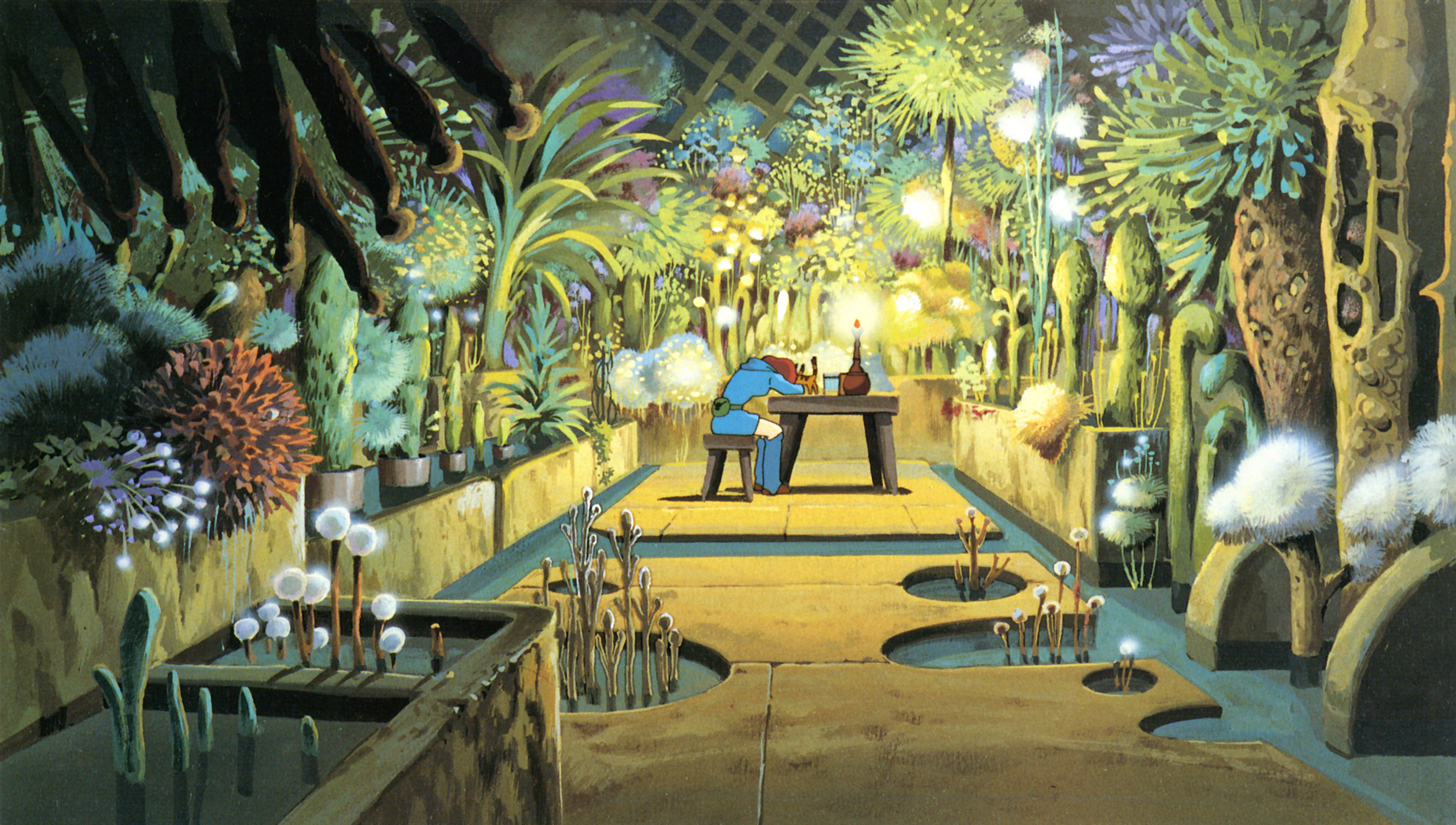 Her greatest strength
though is her ability to compromise while also holding to her morals without
compromise. She is as kind as Chihiro and as strong as Princess Mononoke. She
is kindness in the face of destruction and power in the face of peace. Her
understanding of the ohmu protects her people and the people in the other
factions. She represents internal power where the other factions use outside
forces to effect the world around them and gain power. She, like Princess
Mononoke enters the final battle. Her goal is to stop the battle where Princess
Mononoke meant to support the clash between man and nature in favor of nature.
She does manage to stop it through her sacrifice and her returning of the young
ohmu.
Her ideals are powerful and beautiful and
do not have high costs like the plans of Kushana's people and the people of Pejite.
She is dedicated to her people, but she is shown to have respect for all living
things. Notable, she has formed a connection with many of the creatures in the
Sea of Decay that threatens them all. She instead looks for an answer as to
what the danger actually is and how to mitigate the dangers that are killing
humans who fail to use proper protection such as what are essentially gas
masks. She is also forgiving. She seeks no retribution against Kushana and her
people who are oppressing Nausicaa's people and the survivors of Pejite who
both use the Valley of the wind where Nausicaa and her people live as a battle
ground for their battles. She is the most intelligent of the three
protagonists, taking a scientific look at the Sea of Decay. Her greatest strength
though is her ability to compromise while also holding to her morals without
compromise. She is as kind as Chihiro and as strong as Princess Mononoke. She
is kindness in the face of destruction and power in the face of peace. Her
understanding of the ohmu protects her people and the people in the other
factions. She represents internal power where the other factions use outside
forces to effect the world around them and gain power. She, like Princess
Mononoke enters the final battle. Her goal is to stop the battle where Princess
Mononoke meant to support the clash between man and nature in favor of nature.
She does manage to stop it through her sacrifice and her returning of the young
ohmu.
Why are
these three characters so important? Each has bravery expressed in their own
way and they are all stubbornly committed to their causes. Miyazaki "encouraged the assimilation and appreciation of foreign
cultural elements" (2) which can be seen in the way these characters
appeal to both cultures more heavily than any other anime. The characters are
both distinctly Japanese in terms of culture and the world, but Miyazaki also
promotes characteristics that heavily appeal to a western civilization. It
intrigued me that Chihiro at ten is so different from the slightly older
characters of Nausicaa and Princess Mononoke. Is it a question of age or is
another personality being expressed? Based on Chihiro's evolution compared to
the relatively static older characters, I would say that it is based on age. At
ten years old, the world is so new still and new things are always being
discovered which may be why Chihiro is able to change so much. She is far more
adaptable, personality wise, than the other characters. She mentally
"grows up" in the course of the story, picking herself up when she
falls and becoming independent and strong. Our other two characters are more
stable in their personality. To compare it to a novel, in golden compass,
everyone has a daemon. When they are children, the daemons have not settled on
a form, changing between multiple animals. At about thirteen (puberty), the
daemons settle into a form. Chihiro's experiences are still forming her base
personality, allowing for more extensive growth. Princess Mononoke and Nausicaa
both live in harsher worlds where death is a regular part of life unlike
Chihiro's modern day lifestyle. They developed most likely throughout their
lives to understand the world they were in and its demands and by young
adulthood, they had chosen their paths. They contain a strength of character
that Chihiro is only beginning to comprehend and they wield it as their
weapons. Nausicaa's strength allowed her to save the baby ohmu that had been
kidnapped by the Pejite faction despite her normally pacifistic approach. She
did not give up when the ohmu turned towards her people, but made a plan to
stop the attack. She wanted to return the baby for the baby's sake as much as
for her people's sake. Mononoke was the unbreakable wall that met the
unstoppable force of Lady Eboshi and human progress. She did not break in the
end, going back to live in the regrowing forest, but nor was she able to
prevent the very event that she had been attempting to stop. She takes her
defeat and picks herself up to continue to protect the forest.
These
characters all share characteristics, but the strongest for me is neither the
physically or mentally strongest: It is Chihiro for her ability to change and
learn and take away her lessons to become stronger. With that attitude, she can
continue to grow stronger while Mononoke and Nausicaa have deceived their own
strength. Each character is fully developed in Miyazaki's films, but showing
the character in its entirety and letting a character grow are different
issues. What Miyazaki gives us in these three films are three examples of what
strength and bravery are. There are different types and none are inherently
better than another. What is crucial is that each of these female characters,
despite their overlaps, are their own character. I wanted to find out if Miyazaki
reused his protagonists and just changed the setting like many writers do or if
they were their own characters- individuals. Miyazaki's protagonists are undoubtedly
individuals both in creation and in the fact that they can operate autonomously
and accomplish great things.
I
apologize for not including our favorite antagonists. It just didn't fit in the
scope of the paper!
(1) "Confronting Master Narratives: History As Vision
in Miyazaki Hayao's Cinema of De-assurance" by Susan Napier. http://muse.jhu.edu/article/27987
(2) "Forest Spirits, Giant Insects and World Trees:
The Nature Vision of Hayao Miyazaki" by Lucy Wright. http://go.galegroup.com/ps/retrieve.do?tabID=T002&resultListType=RESULT_LIST&searchResultsType=SingleTab&searchType=AdvancedSearchForm¤tPosition=1&docId=GALE%7CA143027227&docType=Article&sort=RELEVANCE&contentSegment=&prodId=AONE&contentSet=GALE%7CA143027227&searchId=R1&userGroupName=coll33478&inPS=true&u=coll33478&authCount=1
(3) "Matter Out of Place: Carnival, Containment, and
Cultural Recovery in Miyazaki's Spirited Away" By Susan Napier. http://www.jstor.org/stable/pdf/25064646.pdf
(4) https://en.m.wikipedia.org/wiki/Nausicaä_of_the_Valley_of_the_Wind_(film)
(5) https://en.m.wikipedia.org/wiki/Princess_Mononoke
Pictures:
https://blogger.googleusercontent.com/img/b/R29vZ2xl/AVvXsEhx7sbOQOdgwS4GcFDHYMz3AQywvzWdiX3-m6xLG2UytInsFsZt8ABpt-jC6aFRSLYN6YhtQtqhc4ckq_ML_O61-YBZm4i5aUTuQ8DgOMdbp0HUCJbCcVmkbgyY-txlEM99-P-BZUJh0Rh4/s1600/ChihiroDragonhaku.png
https://visocki.files.wordpress.com/2012/02/sa_cry.jpg
https://s-media-cache-ak0.pinimg.com/564x/c6/9c/be/c69cbe503b8277bad5adc9f13c8f749b.jpg
http://entropymag.org/wp-content/uploads/2015/03/the-great-japanese-epic-from-studio-ghibli-princess-mononoke-1997-princess-mononoke.jpeg
http://anime.astronerdboy.com/wp-content/uploads/blogger/-DGMRP8uG4VI/Tdx-ffv4udI/AAAAAAAAWhE/6NLH__xqqKg/s1600/13%2Bsaving%2Bthe%2Bbaby%2BOhmu.jpg
https://partofyourworldksu.files.wordpress.com/2015/03/nausicaa-nausicaa-of-the-valley-of-the-wind-33424551-3390-1920.jpg
http://www.indiewire.com/wp-content/uploads/2014/02/the-films-of-hayao-miyazaki.jpg


 It actually was the inspiration for the games of make believe that my neighbor and I would play and I think it started me down a path that eventually led me to start writing (I am now a creative writer). I remember being scared by all of the villains and loving the way the Sailor Scouts could utilize their powers. Each season had a new version of the same overarching enemy and we were given more and more of the dark past that led to the Sailor Scouts coming to Earth. When It stopped being shown on the TV channels I had, I was heartbroken- It contained, after all, my first crush- Tuxedo Mask.
 I graduated to Naruto a few years later though and it was the only show that I made sure to watch whenever it was on. I think I've seen 300 episodes of it and its continuation and still didn't make a dent in the show. I enjoyed it because of the different styles and magics in the show as well as the darkness and heavy themes that it contained. By this time, I had realized that I liked dark themes far more than comedy.
 It is an American made anime that would honestly fit in perfectly with the Japanese anime in terms of the tropes it includes such as being focused around school girls and the use of big busted people. The animation style Is certainly an anime style and it is captivating to explore the unique weapons and abilities of each character. The series also grows increasingly dark, starting light and growing gradually more severe. Theme songs in particular for this anime are striking because you can try to decipher the lyrics to see what that season holds and at the end of a season it all makes sense and the energy of the theme song is also telling. Like many other anime we have seen, all of the music in the anime was created for the anime, by the character voice actors in this case. The characters themselves are based off of different fairy tales which are something I hold near and dear to my heart. The main team that the show follows is made up of Little Red Riding Hood, Goldilocks, Beauty and the Beast, and Snow White and it is interesting to see how they reflect their fairytales.
 ruby
 Weiss
 Yang
 Blake


